





- November 14, 2025 - Planétarium : Astronomical News
Of all the annual meteor showers, the Geminids are among the most reliable and prolific. In 2025, the Geminids will be reaching their peak on the night of December 13 to 14, around 10:00 p.m. (EST).
When they hit their peak activity this year, on December 13 at 10:00 p.m. (EST), they may produce as many as 100 to 150 meteors per hour (the so-called ZHR), outclassing even the famous August Perseids! In the Montréal area, however, we’re expecting to see about 50 meteors per hour at peak activity, or just under one meteor per minute.
Some basic data
While most meteor showers (shooting stars, in popular language) are fueled by comet dust, the Geminids are the only one whose source is an asteroid: 3200 Phaethon.
3200 Phaeton makes one revolution around the Sun every 523 days. Each year around mid-December, Earth grazes the orbit of 3200 Phaethon and passes through the wake of billions of particles left behind by the asteroid in space, giving rise to this renowned meteor shower.
The Geminids in detail
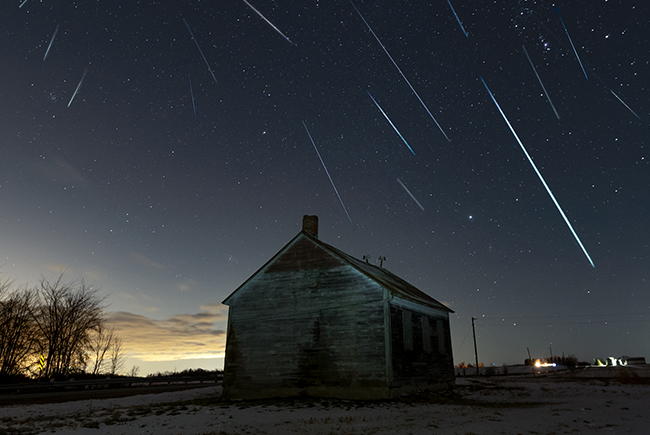
When meteoroids enter the atmosphere, they burn up, producing bright trails known as meteors. The Geminids have an average velocity of 35 km/sec, about half that of the Perseids. They are generally yellow, orange, or green, depending on their chemical composition.
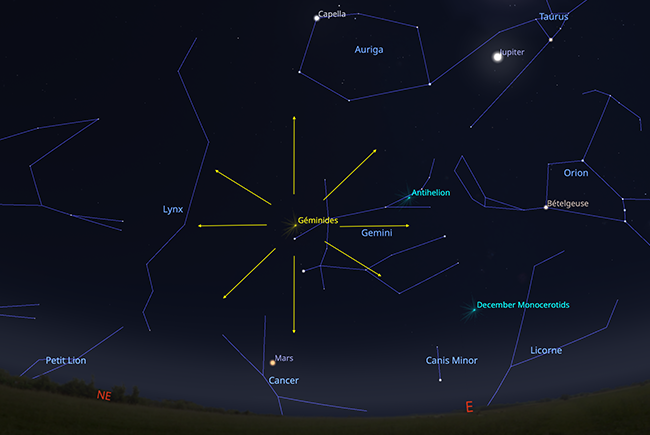
The radiant, the part of the sky where the meteors appear to emanate, is located in the constellation of Gemini, near the bright stars Castor and Pollux. During the night, it will be possible to observe other meteors in the sky, ejected by other celestial bodies. However, you can recognize the Geminids by tracing their light trail back to their radiant point in the constellation Gemini.
In 2025, we can expect a spectacular display throughout the night of the 13th, until the early hours of December 14. This shower is known for producing many bright and spectacular fireballs. This year, viewing conditions will be much more favorable than in 2024: the crescent moon will not rise until shortly after 3 a.m. EST, so it will not interfere with meteor visibility until late in the night.
How to observe the Geminids
As twilight ends, let your eyes wander across the sky. If you’re in a group, position yourselves so that everyone’s facing in a different direction...and be prepared for a few surprises! Under a dark country sky –depending on cloud cover—you can reasonably expect to see several meteors per hour throughout the night of December 13 to 14.
So the rest is up to you: Head out of the city, away from light pollution; bring a lawn chair, blankets and some hot chocolate; and above all, dress warmly! Then settle back, scan the sky with your eyes (binoculars are of no help in this endeavor) and begin counting shooting stars…
Come observe meteors with us during the Skywatch Gatherings at the Planétarium on December 13!