
Find an animal
-

Broad-snouted caiman
The green color with grayish tones of the broad-snouted caiman enables it to camouflage itself in areas that are thick in vegetation.
Its short, sturdy snout is as broad as its head.
ClassReptiliaOrderCrocodiliaFamilyAlligatoridae -

Brook trout
The colouring of the brook trout's marbled markings varies with age and environment. The back varies from olive green to black. The flanks are marked with pale spots and red spots with blue halos.
ClassOsteichthyes (bony fish)OrderSalmoniformesFamilySalmonidae -

Canada lynx
The coat of the Canada lynx is silver grey in winter and brown in summer. This feline has a tuft of long black hairs at the tips of its ears. The end of its short tail is black.
ClassMammaliaOrderCarnivoraFamilyFelidae -

Cane toad
The cane toad (Rhinella marina) is among the largest terrestrial amphibians. Its golden eyes with horizontal pupils and stocky body make it easy to recognize.
ClassAmphibia (Batracia)OrderAnuraFamilyBufonidae -

Capybara
A capybara, the world's largest rodent, looks like a giant guinea pig. It has a large rectangular head with large brown eyes and a blunt muzzle.
ClassMammaliaOrderRodentsFamilyHydrochoeridae -

Cedar waxwing
The cedar waxwing is a greenish brown bird with a black crest and mask.
ClassBirdsOrderPasseriformesFamilyBombycillidae -

Chinstrap penguin
The chinstrap penguin has the classic penguin coloring, a black back and a white belly. The top of the head is black, but the face and throat are white.
ClassBirdsOrderSphenisciformesFamilySpheniscidae (penguins) -

Common eider
Common eider males (winter and nuptial plumage) have black bellies and white backs, a black cap and a green wash on the nape. The female resembles a large brownish duck.
ClassBirdsOrderAnseriformesFamilyAnatidae (geese and ducks) -
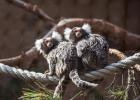
Common marmoset
The common marmoset is a small monkey whose head has two tufts of long white hair at ear level. It has a white blaze on its forehead and a black-and-white banded tail.
ClassMammaliaOrderPrimatesFamilyCallichthyidae -

Common moon jelly
Common moon jellies are easy to recognize by their translucent, disk-shaped body, called a bell, edged with about 1,200 short tentacles.
ClassScyphozoaOrderSemaeostomeaeFamilyUlmaridae