

Pelagic fish populations such as mackerel and herring—traditionally used as bait in crustacean commercial fishing—are in decline and have been under a moratorium in Canadian waters since 2021. At the Biodôme, Dr. Nathalie R. Le François and her team, along with academic, industrial and biotechnology partners, are exploring an eco-friendly alternative: using microalgae cultivated in photobioreactors as a sustainable replacement for industrial fishing.
The new bait would be produced from low-trophic-level species found at the base of the food chain, such as microalgae as well as insects.
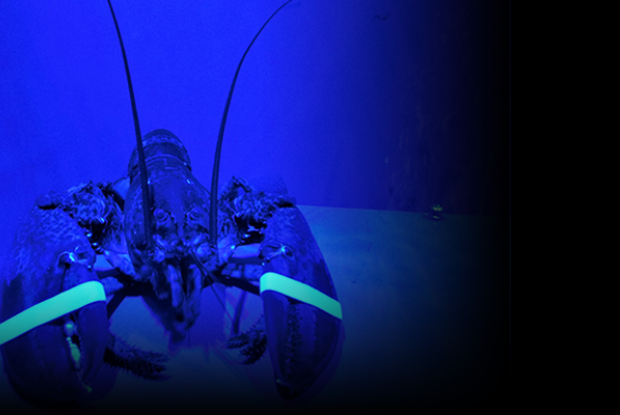
Trials were conducted on the American lobster (Homarus americanus) at the Laboratoire de physiologie, aquaculture et conservation (LPAC) at the Biodôme, over a period of three fishing seasons, thanks to support from the Fondation Espace pour la vie.
Promising new baits currently under testing
The results observed by Le François’s team are so promising that a new research program is now being developed in collaboration with Université Laval, Université du Québec à Chicoutimi, the Wolastoqiyik Wahsipekuk First Nation (WWFN), the École des pêches et de l’aquacuture du Québec (school of fisheries and aquaculture of Québec), the National Research Council of Canada, and commercial crustacean-fishing organizations from Atlantic Canada. The project will address remaining questions around production, attractiveness, composition, and the socioeconomic considerations involved in developing a Québec-based supply chain for alternative bait.
In 2025, preliminary sea trials on American lobster were successfully conducted in Havre-Saint-Pierre, in the Côte-Nord region. These provided a first commercial-scale experience using such a prototype bait, with encouraging results.
Controlled-environment trials on snow crab (Chionoecetes opilio) were also carried out by the Biodôme at Université Laval's Laboratoire aquatique de recherche en sciences environnementales et médicales (LARSEM—aquatic research laboratory for environmental and medical sciences), in collaboration with Dr. Grant W. Vandenberg’s team.
Discover the first field trials for green-urchin fishing with the WWFN off the coast of Cacouna (in French only):
Funding is provided by the Espace pour la vie Foundation, the Wolastoqiyik Wahsipekuk First Nation and Université Laval.