
Insects and other arthropods
Search for an insect or an arthropod
-

These spiders, which often live indoors, are recognizable by their long, thin legs and their elongated, greyish-white bodies. The females’ legs are five or six times as long as their bodies, which measure about 9 mm. The males are slightly smaller.
ClassArachnidaOrderAraneaeFamilyPholcidae -

The luna moth is one of the most beautiful moths. This magnificent insect, with its feathery antennae, is characterized by its emerald green colour and the extension of its back wings. The brown border of its back wings looks like a branch when the moth is resting.
ClassInsectaOrderLepidopteraFamilySaturniidae -

This stick insect lives in two forests located at the northernmost tip of Madagascar. Together, these forests cover just 65 square kilometres. Both sites have been protected from deforestation since 2008.
ClassInsectaOrderPhasmatodeaFamilyPhasmatidae -

These crickets may be various shades of yellow, green and brown. Their legs are often reddish, with black joints on the hindlegs.
ClassInsectaOrderOrthopteraFamilyAcrididae -

These black or dark brown bugs measure from 16 to 22 mm long. They have an elongated, oval shape and a small head with sharp mouthparts. They use this beak-like “rostrum” to spear their prey so that they can feed on it.
ClassInsectaOrderHemipteraFamilyReduviidae -

These moths are recognizable by the two curved white lines on their forewings. The middle part of the wing is a lighter brown than either end. The wingspan is 15 to 30 mm. At rest, the moths adopt an odd posture, holding their wings flat and curving the abdomen upward.
ClassInsectaOrderLepidopteraFamilyPyralidae -
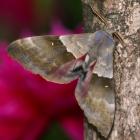
These are large moths, with a wingspan of 9 to 14 cm. The forewings are marked with bands alternating between grey and brown. The hindwings are reddish, and bluish-grey at the base.
Mature female caterpillars can reach 9 cm. Male caterpillars are generally shorter (7.5 cm).
ClassInsectaOrderLepidopteraFamilySphingidae -

The monarch is one of Quebec’s largest diurnal butterflies. It has orange wings with black veins and a wingspan of 9.3 to 10.5 cm. This butterfly is well known for the spectacular migration that eastern North American populations undertake each autumn to Mexico.
ClassInsectaOrderLepidopteraFamilyNymphalidae -
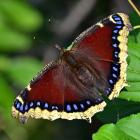
This large butterfly has a wingspan of 6 to 8 cm. Its wings are purplish brown, with a line of blue spots along a yellow border. Males and females look alike.
ClassInsectaOrderLepidopteraFamilyNymphalidae -

This North American walkingstick, known for its outstretched legs, can appear either green or brown. It is the only walkingstick species found in Québec.
ClassInsectaOrderPhasmatodeaFamilyDiapheromeridae