






- July 9, 2025 - Insectarium : Mission Monarch
We sometimes hear criticisms about the relevance of Mission Monarch, our participatory science program that maps the monarch butterfly’s breeding grounds. Those criticisms come from people who care about the conservation of the emblematic species, but who are skeptical about the usefulness of collecting data on its reproductive habitat while the migratory population in eastern North America declines.
Messages like “It’s too late to collect data. It’s time to act! When there are no monarchs left to count, what good will your data be?” illustrate that frustration. But collecting data is a way to act, complementary to other conservation strategies like land acquisition and protection, and initiatives for planting more flowers, among others.
We’re a very small team specializing in the creation of educational resources with positive environmental impact. Mission Monarch makes its platform and data open access, so that the general public, parks, museums, municipalities, NGOs and governments can use them and thus support conversation efforts.
In short, it’s understandable that people feel frustrated about the monarch’s fate in Canada and the fragmentation of its habitat, but that frustration can be turned into action. Science takes time, and Mission Monarch’s approach is anything but futile.
Here are five reasons for mapping the monarch’s breeding grounds:
1. Supporting research, decision-making and defense of the environment
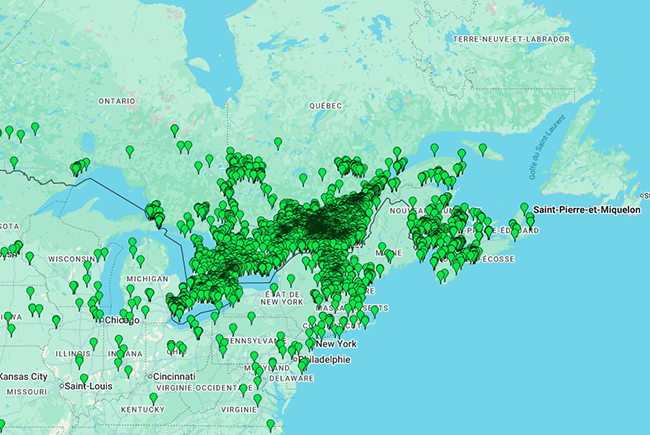
As a museum institution, the Insectarium is mandated with showcasing the relationship between humans and insects and with developing teaching resources as well as tools that document our entomofauna. Those data are invaluable in supporting research, making decisions and protecting the environment. According to Maxim Larrivée, the Insectarium’s director, before the launch of Mission Monarch there were just a few hundred records of milkweed across Canada. Today there are more than 570,000!
When we map the breeding grounds, we’re identifying critical areas for the monarch’s survival. That makes it possible to concentrate conservation efforts where they’re most required. It can also help land managers in planning development projects that minimize negative impacts on these sensitive habitats.
2. Raising public awareness and education
Mission Monarch aims to educate the public and raise awareness about butterfly conservation. By involving citizens in data collection and encouraging them to organize habitats that are monarch-friendly, we’re expanding our conservation efforts. The educational activities and resources created in the framework of this program help promote a culture of conservation and a biophilic society.
3. Taking action that benefits biodiversity
Citizen initiatives like green alleys, balconies in bloom and community gardens are often motivated by a heightened awareness. Through participating in Mission Monarch, people develop a sense of environmental responsibility that translates into concrete action in support of pollinators and biodiversity in general.
4. Ensuring continuous population monitoring
Cartography allows us to track the evolution of monarch populations over time. That surveillance helps scientists detect trends and make recommendations for intervention. This study is part of an international effort aimed at protecting migratory populations.
5. Preserving the monarch for future generations
The goal of mapping and conservation efforts is to guarantee that future generations are able to admire the monarch. Preservation of this emblematic species is essential in maintaining biodiversity. Ensuring the monarch’s survival today means offering our children and grandchildren the opportunity of discovering and enjoying this magnificent butterfly.
Without data, we’re operating in the dark. The scientific approach is built on the analysis and collection of information to guide our actions in an enlightened way. Mapping the monarch’s breeding grounds is no mere academic exercise: it’s a crucial step that informs decisions on conservation.
Each piece of data collected, by you or by us, contributes to a better understanding of the butterfly’s needs and to developing effective protection strategies. Whether it involves taking part in data collection, raising the awareness of your community or making a donation to Mission Monarch, every contribution is valuable. Together we can make all the difference and ensure that the monarch continues to beautify our landscapes for future generations.
See our tutorial : 4 steps to help monarchs