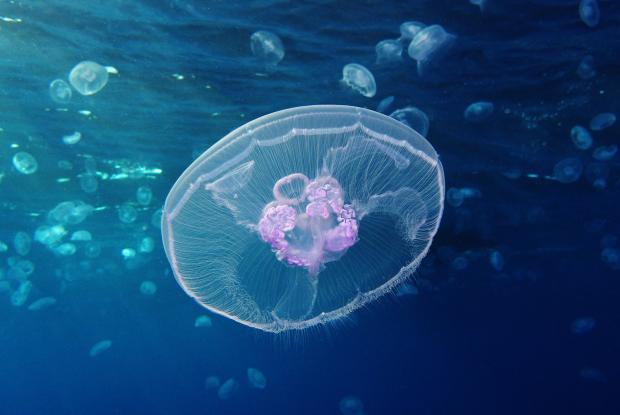
The life cycle of the moon jelly (Aurelia aurita) has two main stages: a polyp stage, attached to the seafloor, and an adult stage called a medusa.
Adult jellies are sexual. In the fall, males, recognizable by their pink to purple gonads, release sperm into the water. Females capture it to fertilize their eggs, which are still held in their pale, whitish gonads. The embryos then develop in a specialized pouch on the female’s oral arms, which shelters them until they hatch.
Hatching produces a tiny larva called a planula, only about 1 to 2 mm long. It swims briefly before attaching to the seafloor, beginning the second phase: the polyp. The polyp looks like a small sea anemone, anchored at one end, with a mouth surrounded by tentacles at the other to capture food.
Common moon jellies can remain in the polyp stage for several years and may form small colonies that carpet the seafloor.
When conditions become favourable, usually toward the end of winter, the polyp begins a segmentation process and turns into a strobila. Through strobilation, it divides into a stack of sections and releases tiny young jellies called ephyrae. This asexual stage produces large numbers of genetically identical individuals.
The young jellies grow steadily and reach adult size in about three months.